Posts

Event 3- African Print Fashion Now!

Image
For our 3rd event, I visited the Fowler Museum on campus, and specifically went to the "African Print Fashion Now" exhibit.  I found this exhibit to be super interesting and I was not even aware this existed on our campus.  I have never learned about African fashion, so it was a new topic I got to explore. African dress is characterized with bright colors, bold images, and complex patterns.  This is mainly worn in the countries of west and central Africa, and although the trends vary from country to country, the overall theme remains the same.  This exhibit covered all aspects of African fashion from runway, to youth trends, to local seamstresses. African fashion began to bloom in the twentieth century, and was seen all over the globe as it gained popularity.  The designs are used to depict issues such as identity, displacement, and hybridity, while combining art and fashion.  The cloth worn by the women are seen as her measure of wealth and taste, so a...

Week 9- Space + Art

Image
This week we studied space and art, and as Vesna said, it combines all the lessons into a final one.  It was amazing to see how art the combination of space and art has been so influential.  Space has always been an area of uncertainty for humanity, which then ignites curiosity.  For those who are not astronauts and able to physically explore space's surface, art is another way to join the movement. One way art has influenced space is through the Leonardo Space Art Project, a group of individuals who are working together to investigate and promote the cultural dimensions of space activities.  One exhibition is done by B. E. Johnson, where he creates paintings encompassing space. He considers himself a "method painter" and completely immerses himself in the culture he is creating.  His goal is to inspire the next generations to explore space, which is a way the art world is helping expand the space world. Another huge way that the art world has explored space...

Week 8- Nanotech + Art

Image
The phrase, "seeing is believing" is one that does not apply to nanotechnology, as there is no proof of existence.  The data is completely collected through sensing on an abstract level. In this week's reading, I discovered the world of nanotechnology, which I had never looked into before.  There is a range of outlandish nanotech products that are attempted to be produced.  The government even sees this as a possible solution for declining economies.  The  nanometer is also so small it has been compared in relation to "a human head compared to planet earth." Magnification is one way we are able to expose the art within nanotechnology.  It was discovered that a needle could be used to map the atoms.  Until the 1980s, the idea to change the arrangement of atoms was not even viewed as possible. Works of art developed through nanotechnology combine art, science, and technology.  At the Perth International Arts Festival exhibition, many of these ...

Week 7- Neuroscience + Art

Image
Our materials this week covered neuroscience involving the brain, memory, and consciousness.  This is a topic I have previous experience with, having taken Psychology 10 last quarter.  In Vesna’s lecture one video she discusses neuroscience and art and describes it as an exploding field that artists find interest in because of the mind.  Because neuroscience is so broad and so relevant to humans and their lives, it is a prevalent subject.   The brain and mind have always been areas of interest for humans, and there is a long timeline of scientists who have explored these.  Franz Gall was one of the first who practiced phrenology: the belief that bumps on one’s head directly related to the human’s intelligence or brain size.  Consciousness is defined as a sense of one’s personal or collective identity, including the attitudes, beliefs, and sensitivities.  I believe a way that consciousness can be related to art is through dreams.  Dreams are a...

Event 2- Hammer Museum

Image
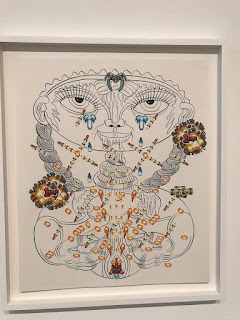
For our second event, I decided to visit the Hammer Museum.  I had never been before, and since it is so close to campus, I decided to check it out.  My favorite exhibit was by Oliver Payne and Keiichi Tanaami.   This exhibit contained a series of Japanese paintings that were inspired from “bullet hell” arcade games.  Both of these artists combined their individualistic styles to create fantasy style artwork.   This has relations to the Japanese pop art movement that happened in the 1960s and influenced post war Japan.  This exhibit was meant to contribute to the international pop movement through its expansive social and philosophical notions portrayed through the video game characteristics.  This was the first time these artists have collaborated, and it created something very unique and intriguing.  Tanaami sketches the first design.  Payne then adds the bullet hell arcade like features and stickers.  They bring t...

Week 6- Biotechnology

Image
Vesna describes biotech as one of the most controversial areas we will cover in this class.  From what constitutes as biotech, to the ethical use of animals, this topic explores many areas and questions.  Mutating the bodies of animals is a big part of biotechnology.   In Vesna’s lecture, she speaks about French scientist, Eduardo Kac, who is known for his florescent rabbit.  He would take florescent protein from a jellyfish, modify it to make its properties stronger and then insert this protein into the rabbit to make it glow.  This is transgenic art, an art form based on use of genetic engineering and transferring genes to an organism.  Animal rights activists view this art as cruel and unnecessary, and scientists see it as interesting but silly.  Kac believes his experiments helped understand the relationship between genetics, the organism, and the environment.  He created many debates in this field about ethic issues. I believe this...

Week 4- Medicine, Technology, and Art

Image
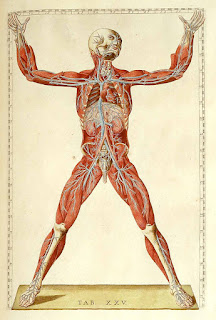
This week we studied medical technologies and art and found that the two have always complemented each other.  In Vesna’s lecture 1, she explains how it began with human dissection and has evolved into X-rays and MRIs.  These inventions are critical for the saving of lives and have stemmed from art.   She continues in lecture 2 explaining how technology began existing in hospitals at the beginning of the twentieth century and it was considered art.  Medicine is an area that continues to evolve by demand and the help of technology.  There are always new discoveries that can help advance the field and help humanity. The MRI is a gr eat example of the combination of medical technology and art.  In her essay, Casini claims “I experienced both the rhythm of MRI and the creative possibilities that it holds” (Casini 77).  She states that the MRI not only has a medical purpose, but can also be seen in an artistic way.  When I further researched MRIs,...

Event 1- Eco-centric Art and Science Week Workshops with Linda Weintraub

Image
This week the event I attended for our first event was the Eco-centric Art and Science Week Workshops with Linda Weintraub.  This workshop was all about the human body and how we perceive senses when we are not distracted by technology and manufactured.  Linda began by asking the group what percent of items we thought we interacted with that had not been manufactured.  Everyone had different guesses but the group consensus was between 0 and 3 percent.  This made me think about and realize that almost everything we come in contact with has been manufactured by humans. We were asked to enter the room without our shoes and spend an hour in silence, observing and interacting with the different boxes.  There were six different categories for the boxes: flavor and aroma, mass and weight, volume and dimension, touch and texture, form and beauty, and bare your soles/souls.  Each box had a different activity and the instructions were written on the box. ...

Week 3- Robotics and Art

Image
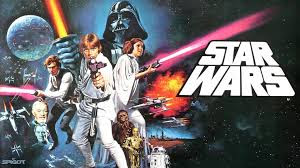
I have always believed that technology and art are areas that complement and help progress each other.   Vespa states that you cannot look at robotics without first looking at industrialization.    Robotics was actually stemmed from artists, as they were the first to envision this blooming field.    The idea came from theater, and was eventually used in movies.    This has eventually led to the science fiction movies that are so common today.    Star Wars, Interstellar, Inception, Avatar, and so many other movies our generation knows and love would not be possible without the blend of robotics and art. https://www.forbes.com/sites/brandonkatz/2016/10/05/would-a-star-wars-tv-show-even-work/#5a4d00364ebb Walter Benjamin in his essay, “The Work of Art in the Age of Mechanical Reproduction,” discusses authenticity and how the social value of work is dependent on the time and place it is created. He says, “ even the most perfect repro...

Week 2- Math and Art

Image
Utilizing a triangle to create a vanishing point in an art piece http://www.cs.ucf.edu/courses/ cap6938-02/refs/VanishingPoints.pdf Mathematics, art, and science are all creative forms intertwined into one body. After reviewing this week’s lecture and readings, I have learned that without mathematics, art and science would not exist. Math provides the basic root in which art and science stem off. As said by Csuri, “The computer language enables me to organize and structure the artistic content and meaning.”  One could not exist without the other.  How one perceives math, art, or science all depends on perspective. For example, an artist utilizes a triangle to create “vanishing points” on their piece to impress the viewer. This formula that creates a vanishing point stems from mathematicians and the way they use the shapes to solve problems. The triangle itself does not change, but the person drawing it alters the shape to fit their certain usage.  Tessalations,...

Week 1- Two Cultures

Image
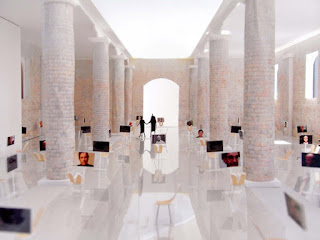
One of the exhibitions created by Hans Ulrich Obrist http://www.e-flux.com/announcements/36565/ two-new-iterations-of-hans-ulrich-obrist-s-ongoing-interview-project/ As an Economics major, I have been made aware of the blend of science and art, as this is not a definite “north” or “south” campus major. It is clear a bridge between the two cultures has always existed, but I had never realized how big of a connection.  Discovering that this blend is referred to as the “Third Culture” has introduced a new perspective into my life as a student and beyond. So many of the things we love are made possible through the combination of art and science. They complement each other and learning how to successfully blend the two can be beneficial to learning. In Snow’s acclaimed lecture at Cambridge, he recognized two cultures consisting of “literary intellectuals” and “natural scientists” (Vesna 121). Four years later, he added a revision claiming that a “Third Culture” would tr...